
Drive more efficiently with timing belts
Save a lot of energy simply, quickly and with little investment? Then switch from V-belts to toothed belt drives!
An old-fashioned V-belt, those with a classic wedge profile, has an efficiency of 90-95% under optimal conditions.
Causes of loss include slippage between the belt and pulley, Internal friction within the belt due to flexing, stretching and compression.
under heavy loads, heat build-up is higher and efficiency decreases further over time due to wear, aging and loss of tension. Furthermore, temperature resistance is limited and speed and power are limited by slippage. The noise level is lower at low loads.
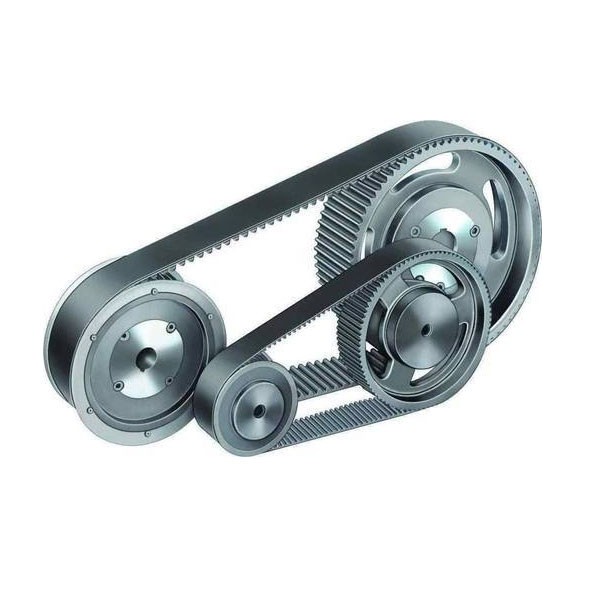
A timing belt (sync or toothed belt) has an efficiency of 96 to 99%, with peaks around 99% in properly tuned systems! Losses here are minimal but those that are there are mainly due to internal bending resistance of the belt itself.
There is no slippage and the efficiency remains stable over its life if properly tensioned.
Temperature resistance is often better than with a V-belt, but depends on the material used. Noise level is higher than with a V-belt but constant
If we look at the implications for energy efficiency, it can be said that in large plants or continuous processes, such as in conveyors, compressors, HVAC systems, and the like , an efficiency difference of as little as 3 to 5% can represent a significant energy loss, especially when viewed over thousands of running hours per year. This translates directly into higher energy costs and ditto higher CO₂ emissions.
For industrial applications, a timing belt is clearly more efficient than an old-fashioned V-belt.
When energy efficiency and reliability are paramount, a timing belt overbelt is preferable.
In addition, today there are so-called modern poly-V belts. These have a higher grip without slip with higher efficiency than classic V-belts.
Below is a sample calculation comparing the energy loss and additional cost of electricity between a conventional V-belt and a timing belt in an industrial drive.
Situation outline:
- Requested continuous power by implement: 25 kW
- Operating time: 24 hours per day, 45 weeks per year = 7,560 hours/year
Electricity price: €0.20 per kWh
Efficiency classic V-belt: 92%
Efficiency toothed belt: 98%.
Energy consumption per year
➤ With V-belt (92% efficiency) -> Power required = 25 kW ÷ 0.92 = 27.17 kW
Annual consumption: 27.17 kW × 7,560 hours = 205,405 kWh
➤ With timing belt (98% efficiency) -> Power required = 25 kW ÷ 0.98 = 25.51 kW
Annual consumption: 25.51 kW × 7,560 hours = 192,855 kWh
Cost comparison
➤ Annual consumption with V-belt = 205,405 kWh x Eur. 0.20 = Eur. 41,081
➤ Annual consumption with timing belt = 192,855 kWh x Eur. 0.20 = Eur. 38,571
A timing belt drive in this situation consumes over 2,500 Euros less electrical energy annually than and V-belt drive! With multiple installations or higher power ratings, the savings add up quickly. In addition, you benefit from less maintenance, less downtime and a more constant output
Contact
Want to know more?
We would love to hear how we can help you with energy efficiency services. With our experience and our extensive workshop, we can help you in the way that suits your business.