
Choose the right gearbox
Choose the right gearbox: bevel gear instead of worm gear
A worm gearbox is often used in bevel gearbox applications. However, it has a relatively low efficiency due to high friction losses. The solution? Helical bevel gearmotors! When an implement needs to be driven at a 90-degree angle with reduced speed/high torque, choose right-angle gearmotors.
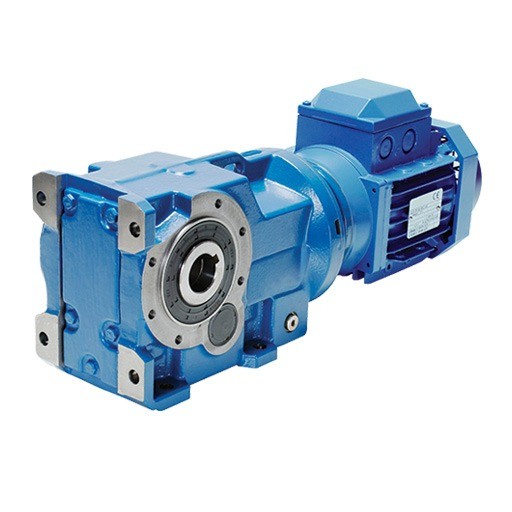
Broadly speaking, there are 4 types of reducers in this regard:
1 - worm gearbox
2 - bevel gearbox
3 - crown gearbox (hypoid gearbox)
4 - planetary gearbox
In industrial applications, you see worm gear and bevel gearboxes used in particular. These are generally readily available/quickly delivered.
The right-angle worm gearbox works with a worm and a worm wheel, with the worm rotating at a 90° angle to the worm wheel. The advantages are: Compact and relatively inexpensive, self-braking at high gear ratios and low vibration and low noise. The disadvantages are: lower efficiency (40-85%), due to high friction, produces more heat, often needs cooling at higher powers and has higher wear due to sliding friction between worm and worm wheel.
The helical bevel gearbox uses bevel gears (e.g. helical or spiral bevel gears) to transmit the force at 90°. The advantages are: higher efficiency (95-98%), thus less energy loss, more durable and wear-resistant due to more efficient transmission, suitable for higher loads and continuous operation. The disadvantages are: more expensive to purchase than a worm gearbox, less compact than a worm gearbox, sometimes needs additional lubrication and more precise alignment.
If self-inhibition is not necessary or even undesirable, the disadvantages (slightly higher purchase price and the fractionally less compactness) of the helical bevel gearbox do not outweigh the much more favorable efficiency compared to the worm gearbox.
A worm gearbox has an efficiency between 40 and 85%, depending on gear ratio and lubrication. A bevel gearbox has an efficiency between 95 and 98% efficiency, regardless of gear ratio.
At a low gear ratio (5:1 - 10:1), a worm gearbox can still have a reasonable efficiency (about 80%). At a high gear ratio (>30:1), the efficiency of a worm gearbox can drop to 40-60%, while a helical bevel gearbox is still 95% or higher.
This means that a worm gearbox consumes 30-50% more energy for the same output power.
Below is an example calculation based on a 22 kW drive where we compare a worm gearbox to a bevel gearbox with a gear ratio of 20:1; Input power 22 kW, efficiency worm gearbox 70% (0.70), efficiency bevel gearbox 96% (0.96)
Calculate output power: 𝑃-out = 𝑃-in × 𝜂
For the worm gearbox: 𝑃-out, worm = 22 × 0.70 = 15.4 kW
For the bevel gearbox: 𝑃-out, cone = 22 × 0.96 = 21.12 kW
The worm gearbox loses 22 - 15.4 = 6.6 kW of heat, while the bevel gearbox loses 22 - 21.12 = 0.88 kW of heat, so 6.6 kW - 0.88 kW = 5.72 kW less!
At 4000 running hours and energy price of €0.20/kWh, this means an energy cost savings of 5.72 × 4000 × 0.20 = Eur. 4,576 per year!
Conclusion: a helical bevel gearbox is much more efficient, especially at higher gear ratios. the power loss is significantly lower, which leads to considerable energy/cost savings. In addition, the helical bevel gearbox is significantly less prone to wear, thus more maintenance-friendly, more durable, as it lasts much longer and therefore more operationally secure. A worm gearbox is a good choice in self-braking applications or low power applications, but not for efficiency and/or durability.
Contact
Want to know more?
We would love to hear how we can help you with energy efficiency services. With our experience and our extensive workshop, we can help you in the way that suits your business.