
Synchronous reluctance motors: the smarter and more energy-efficient choice in frequency-controlled drives!
frequency-controlled synchronous reluctance motors (SynRMs) offer great advantages in terms of efficiency, reliability and durability.
But what exactly are synchronous reluctance motors?
A SynRM is a high-efficiency, robust three-phase motor without rotor windings or permanent magnets. Torque is created by the difference in magnetic resistance (reluctance) in the rotor. The motor always rotates synchronously with the rotating field of the stator. The rotor consists exclusively of laminated steel with specially shaped flux guides and barriers. This creates zones of low and high magnetic resistance. The stator field, controlled by the frequency inverter, always orients the rotor so that the magnetic flux follows the path of least resistance. In this way, the rotor "clicks" along synchronously with the stator field, so to speak.
Advantages over induction motors
Compared to the familiar induction motor, the frequency-controlled SynRM motor has distinct advantages:
Higher efficiency, especially at part load
- No rotor losses due to short-circuit currents → no copper or aluminum losses.
- Easily achieves efficiency class IE5 and soon even IE6.
- Delivers significant (additional) energy savings in applications with variable speed or part-load operation (pumps, fans and compressors).
-
Lower operating temperature and longer service life
- Less losses means a cooler engine.
- Bearings and insulation last longer, less chance of thermal failure.
Better dynamic behavior
- Faster torque response due to synchronous operation.
- Benefits in control applications: faster response to load changes and more precise speed control.
No permanent magnets required
- Durable and cost-effective: no rare earths required.
- Efficiency close to that of PM motors, but at a significantly lower cost.
More compact design possible
- Higher efficiency often allows the engine to be smaller and lighter.
- Ideal in installations with limited space or where weight is a factor.
Lower losses at high speeds
- Reduced rotor losses at higher speeds as well.
- Beneficial in long-term or speed-dependent applications.
Comparable purchase price
- Cost is in line with that of an induction motor of equivalent efficiency class.
Calculation example: 110 kW pump/fan application
When purchasing new motors, the familiar induction motor is often automatically chosen. Yet it pays to look further, especially in frequency-controlled systems that run a lot in partial load.
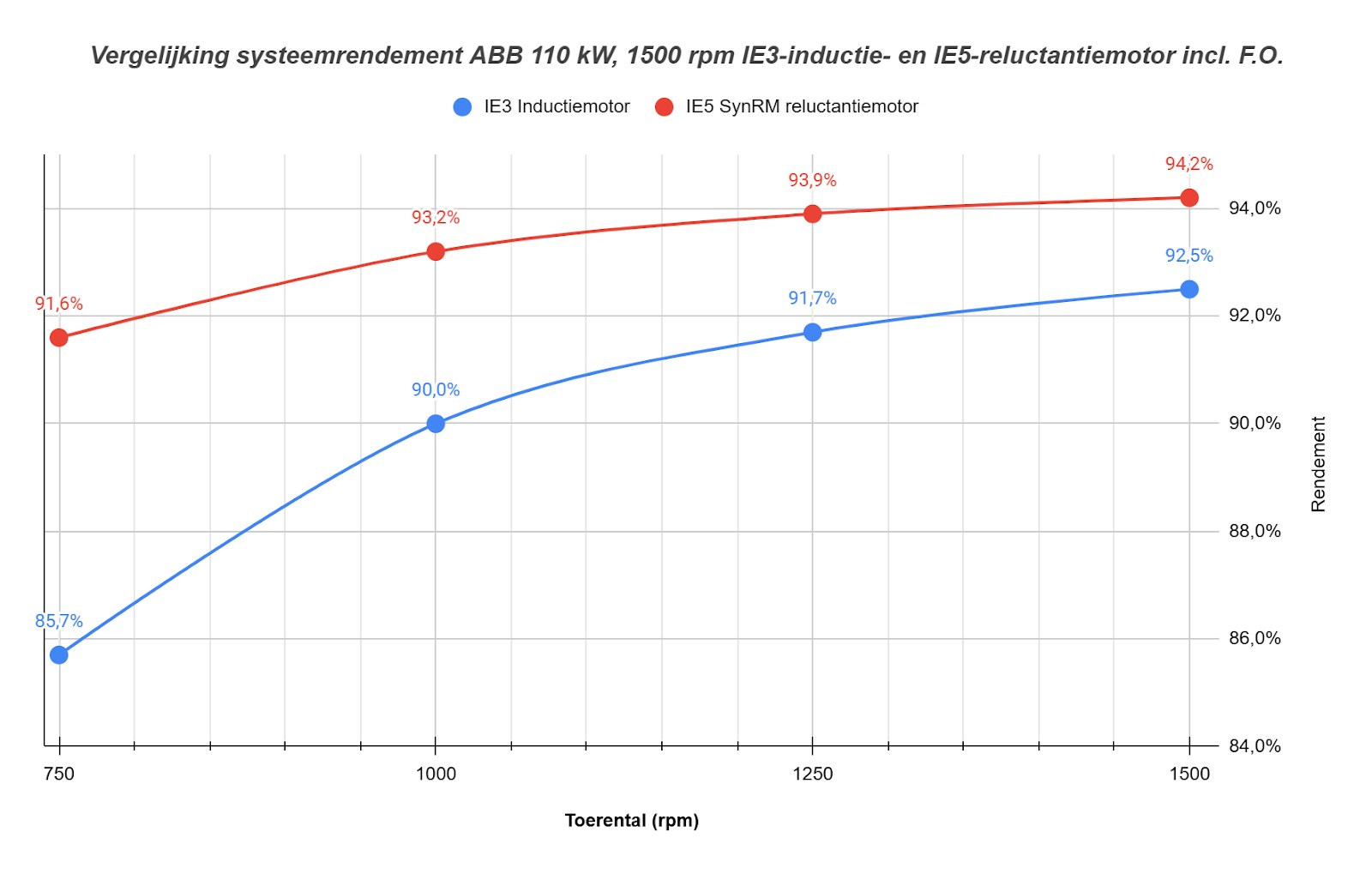
The example below shows the difference in system efficiency between a frequency-controlled IE3 induction motor and an IE5 SynRM motor, with an output of 110 kW and control range of 750 - 1500 rpm:
- Efficiency difference at 1500 rpm: +1.7% for SynRM
- Efficiency difference at 750 rpm: +5.9% for SynRM
Practical translation (8000 running hours per year, of which):
- 2000 hours at 1500 rpm
- 2500 hours at 1250 rpm
- 2500 hours at 1000 rpm
- 1000 hours at 750 rpm
At an electricity price of €0.25/kWh, this results in annual savings of approximately €3,125.
On top of that, there are lower maintenance costs due to the cooler motor, leading to higher operating reliability and availability.
Conclusion
The combination of a SynRM motor and AC drive offers a compelling mix of:
- higher energy efficiency,
- lower operating costs,
- longer life,
- and greater operating reliability.
A smart(er) choice for any modern installation.
Contact
Want to know more?
We would love to hear how we can help you with energy efficiency services. With our experience and our extensive workshop, we can help you in the way that suits your business.